GPT-6.1 Sol vs GPT-6 Astra: when is the higher price worth it?
Compare Sol and Astra specifications, cache and long-context costs, escalation math, and acceptance gates for coding, research, and document workflows.
 Ofox
Ofox 
GPT‑6.1 Sol has one-fifth of GPT‑6 Astra’s Standard uncached input and output unit prices. That makes Sol a reasonable candidate for repeated work, but it does not mean an accepted task will always cost 80% less. Output length, failed attempts, tools and review effort determine the actual cost of a result you can use.
OpenAI describes Sol as offering near-Astra performance for complex work and keeps Astra positioned for its most demanding tasks. This article turns that positioning into a practical decision process using documented specifications and explicit hypothetical calculations. It does not report a head-to-head model test, an equal-quality finding or a universal replacement recommendation. Sources were checked on September 30, 2026.
Specifications do not show the whole quality difference
| Documented characteristic | GPT‑6.1 Sol | GPT‑6 Astra |
|---|---|---|
| API ID | gpt-6.1-sol | gpt-6-astra |
| Input / output modalities | Text and image / text | Text and image / text |
| Total context window | 1,050,000 tokens | 1,050,000 tokens |
| Maximum input | 922,000 tokens | 922,000 tokens |
| Maximum output | 128,000 tokens | 128,000 tokens |
| Knowledge cutoff | April 30, 2026 | April 30, 2026 |
| API reasoning options | low, medium, high, xhigh, max | low, medium, high, xhigh, max |
| Standard ordinary input / output per 1M | $2 / $10 | $10 / $50 |
| Standard cache read / write per 1M | $0.10 / $2.50 | $1 / $12.50 |
Sources: Sol model documentation, Astra model documentation, and model-selection guidance.
Equal context limits do not imply equal handling of a difficult input. A large window is a capacity specification, not a guarantee that all constraints, citations or dependencies will be retained correctly. Similarly, matching reasoning-level labels does not establish identical latency, computation or output quality. Evaluate the final artifact rather than treating the specifications table as a benchmark.
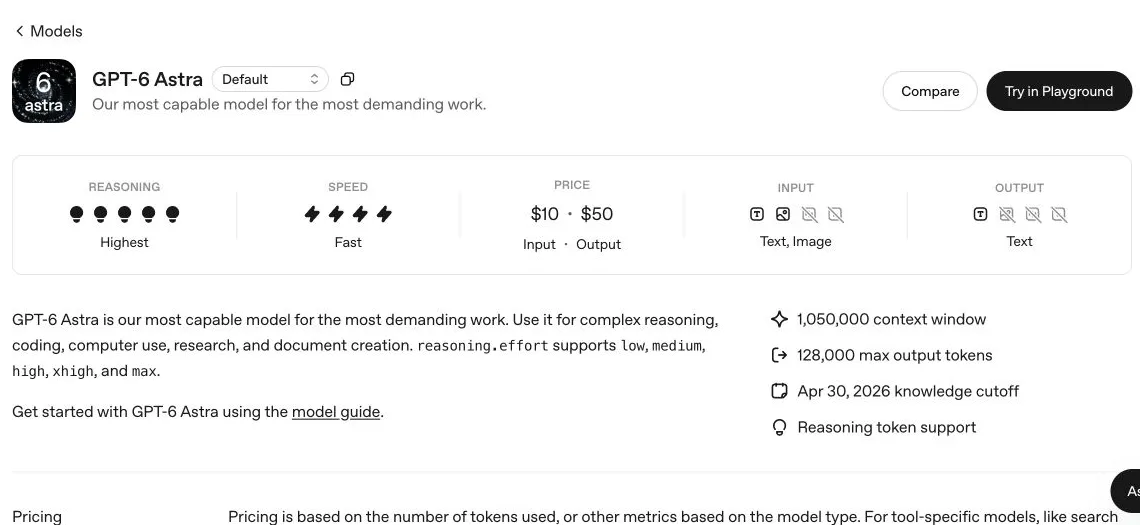
Real English documentation screenshot showing Astra’s published model information. It does not show an executed comparison.
What the price gap means in three cases
For 10,000 ordinary input tokens and 2,000 output tokens, Sol costs $0.02 + $0.02 = $0.04; Astra costs $0.10 + $0.10 = $0.20. Both are Standard, short-context API examples with no tools, caching or regional premium. On these fixed quantities, Astra is five times the price.
Now add substantial reuse: 10,000 ordinary input, 100,000 cache-read tokens and 2,000 output. Sol costs $0.02 + $0.01 + $0.02 = $0.05; Astra costs $0.10 + $0.10 + $0.10 = $0.30. The ratio is six, not five, because the cache-read rates differ by ten times while other rates differ by five. Initial cache writes and cache misses are excluded from this isolated read example and must be added to a real sequence.
For a long uncached request with 300,000 input and 10,000 output tokens, Sol costs $1.35 and Astra $6.75. Both exceed the documented 272K input threshold, so input/cache rates double and output rates increase by 1.5× for the entire request. It would be wrong to apply the short rates to either model or charge only the excess tokens at the premium.
These are price comparisons under fixed usage, not forecasts of token demand. If one model takes more turns, generates more reasoning tokens, or needs manual repair, the real ratio changes. Use the detailed cost guide to build a request ledger before calculating cost per accepted task.
Start with the failure you need to avoid
For narrow code changes with clear tests, Sol is a sensible first candidate: the acceptance signal is available, repeated attempts can be bounded, and incorrect work can be rejected before deployment. Preserve the same test environment and avoid granting wider permissions just because you changed models.
For tasks with many interacting constraints—such as a cross-module redesign, a difficult investigation or a long research synthesis—Astra is worth evaluating directly. That recommendation follows its official positioning and the higher cost of undetected mistakes, not a measured claim that it will always succeed. Break the task into checkable outputs even when choosing the stronger-positioned model.
For document preparation, compare the delivered file and evidence. A polished-looking answer can omit a required section, contradict a source or invent a number. If those defects are easy to detect, a cheaper first pass may work well. If they require expert review, include that review in the decision rather than using token cost as the sole criterion.
| Situation | Candidate strategy | Required gate |
|---|---|---|
| Repeatable extraction with a schema and source checks | Sol first | Schema validity plus source accuracy |
| Small bug fix with regression coverage | Sol first | Tests and scoped diff review |
| Ambiguous design with costly rework | Compare Astra directly against Sol | Explicit constraints, expert acceptance and revision count |
| Long cited research | Compare both on the same source set | Citation support, conflicts and omitted evidence |
| Consequential write or deployment | Either model proposes; application controls execution | Human or policy authorization appropriate to the action |
The task categories suggest experiments. They are not performance results from this article. A reliable workflow still needs validation, permissions and a rollback path whichever model produces the proposal.
Calculate a Sol-first escalation policy
Suppose one Sol attempt costs Cs, one Astra attempt costs Ca, and a fraction p of tasks is escalated after the Sol result fails a reliable acceptance check. Under a simplified policy of one attempt at each tier:
Expected token cost per submitted task = Cs + p × Ca
Sol-first costs less than Astra-first when p < 1 − Cs / Ca
Using the $0.04 and $0.20 short-request examples, the threshold is p < 0.80. If 25% of tasks escalate, the arithmetic is $0.04 + 0.25 × $0.20 = $0.09, compared with $0.20 for an Astra attempt on every task. This is a hypothetical budget, not an observed escalation rate or a measured 55% saving.
Several assumptions can break the example. The Astra retry may receive extra failed history and cost more than Ca. Sol’s failure may be missed by the validator. Astra can also fail, requiring another attempt or human work. Tool costs, latency and review time are excluded. A task counted as submitted is not necessarily accepted, so do not label this formula “cost per success” without adding outcomes.
A useful production ledger therefore stores first-tier cost, reason for escalation, second-tier cost, final acceptance and manual correction. If the validator lets bad answers through, a low escalation rate can be a warning rather than a success. Sample accepted tasks for review, and track undetected errors as well as explicit failures.
Build an acceptance gate before adding routing
For a coding pilot, freeze a synthetic repository or a disposable branch and define the expected behavior in tests. Give each model the same files, instructions and allowed tools. Record model, reasoning setting, client, date and environment. Keep the initial comparison free of unrelated prompt and harness changes so you can understand what caused a difference.
Require a patch, passing relevant checks, no unrelated edits and an explanation supported by the actual diff. Measure total elapsed time, output usage, tool usage and review effort. For a research pilot, replace code tests with a list of claims that must be supported, required sources and a check for conflicting evidence. For a document pilot, inspect the exported document rather than only a chat summary.
Choose the escalation rule in advance: missing required evidence, a failed regression, repeated tool errors, or unresolved contradictory constraints. Avoid a vague “the answer feels weak” trigger if the system will route automatically. Send Astra the original task, trusted evidence and a concise verified failure summary; do not promote the first model’s unverified assertions into facts.
Keep a bounded retry count and a terminal “needs review” state. Escalation is a recovery attempt, not permission to run indefinitely. Rollback must restore the previous routing configuration without erasing the evaluation records.
Migration details that can invalidate a fair comparison
Sol requires Responses for tool calls. A broken Chat Completions integration can make Sol appear incapable when the request itself is unsupported. Check the tool migration walkthrough before recording a failure as a quality result.
Likewise, a long conversation may cross the price threshold on only one attempt because its accumulated history differs. Compare actual input quantities and record whether caches were warm. Do not give one candidate a fully prepared source bundle and ask the other to spend tool calls finding it, then attribute the cost gap entirely to the model.
Finally, API prices and subscription usage are different systems. The dollar examples here do not calculate how many Codex tasks your plan includes. See Codex setup and access for that distinction. The practical decision is which verified workflow meets your quality and time requirements at an acceptable total cost, not which model wins a specification row.